Annexation & Land Use

Once a parcel is annexed into the city, the City of Stuart often struggles with what land use to give the parcel.


The reason most people annex into the city is because Stuart allows for greater density than unincorporated Martin County. However, an annexation does not mean that the property owner is ready to do anything with the land. Sometimes, it can sit for years without a request to change the Future Land Use (FLU). During that time, it will keep the county’s zoning.
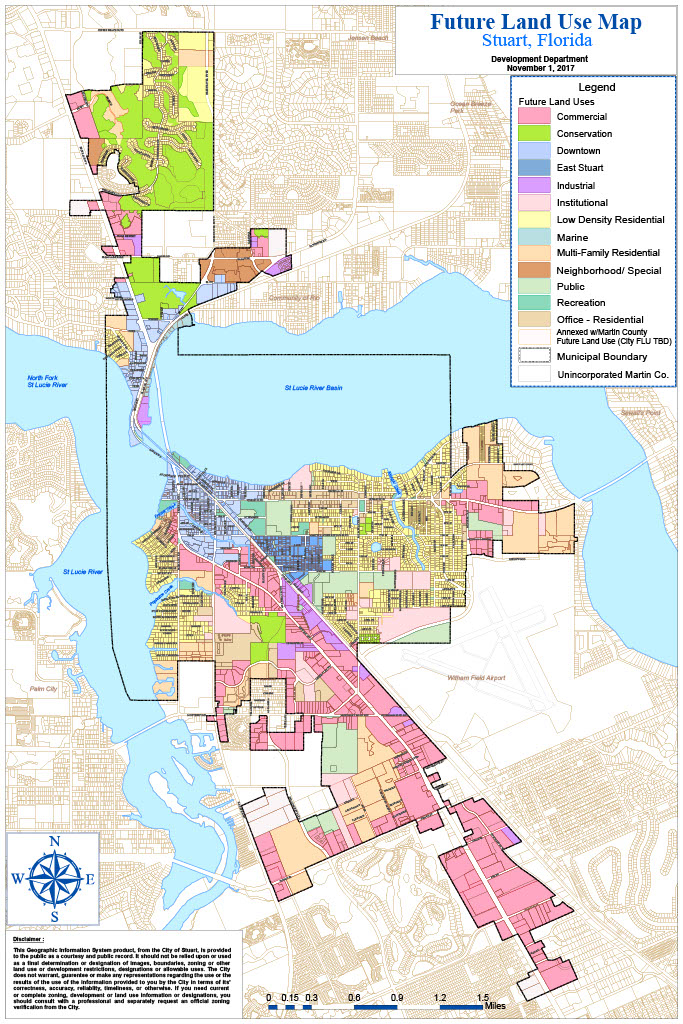
Once the landowner or developer is ready to build something, then he will come to the city and, as a first step in the process, ask for a FLU change. That is what happened with Costco, and for some, it was as if the world came to an end. So, upon annexation, should the city assign a future land use designation also?


Again, the Kanner CPUD became such a focal point because the county had given the property a zoning designation that allowed 5 homes per acre. Of course, that use was assigned decades ago. If that land use was allowed to stand, the property would have been worth a fraction of the amount that was paid.


There are two reasons a FLU is not assigned upon annexation. There is no idea what eventual use will be asked by the owner. The second reason is that if a land use is automatically given, then the commission may not need to weigh in when an eventual project is ready. Hard for a politician to bear.


After years of studying this very problem, I would contend that upon annexation, the land should be given the highest appropriate land use possible unless the owner wishes another one. But FLU needs to be part of the annexation.


Currently, a piece of land of approximately five acres on Willoughby that abuts the Kanner PUD is on the market for $3.295 million. That property was annexed into the city with its old Martin County land use. It isn’t being offered for sale at that price to build a few houses.


Interestingly, I have been told that the property is owned by a relative of Ms. Richards. She was the intervenor on the Costco parcel and wanted to keep the land use at 5 homes per acre. When this comes into the city, will she be fighting against the rezoning?


This parcel should be given the highest FLU now and that should be given the same land use as the Kanner CPUD. It is fair and is in conformity with the rest of its surroundings. It, too, is full of debris. Will Ms. Cartwright (the nemesis of the Costco development) treat her pal, Richard’s relative to the same tactics she is now employing with the Kanner CPUD mentioned in my companion pieces? It could result in the loss of couple of million dollars to the family of her ally and friend.

Is It Paradise Lost Or Another Junk Yard?

How many emails does it take to have the results that you seek? Robin Cartwright must think if she sends enough email, then she will have her results which is to stop the Kanner CPUD.


I have just read quite a few emails that she has sent to the city from late December through mid-January. She has claimed that the developer of the Kanner CPUD (Costco) has continuously exceeded what he is allowed to do with his permits. When pressed, however, for details about what exactly was wrong, she has only used generalizations such as, “We took a drone video this morning of the property. Please be advised that more than trails were cleared. Additionally, there are activities taking place on the property right now, which may or may not be “legal” as there is no silt fence nor chain link fence up…” An inspection made by the city building inspector showed no code violations going on.


The emails continued but without any proof of violations. At one point Mayor Matheson became involved. It appears he was giving direction to staff about going to the property. The development director sent an email to the building official on January 19th referencing the mayor asking him to send someone out to the site. Photos taken from a drone by Cartwright were the basis of the complaint though no footage was forthcoming.


When asked by City Attorney Mike Mortell to provide evidence of violations she claimed were occurring, Ms. Cartwright told him to visit the site. So far, every visit to the site has revealed no violations. Mortell wrote to her that she had only made broad accusations as to what was being done in violation of a permit. There has been no specificity to any claim.


Mr. Nicolosi, the building official, visited the site on January 19th. He walked the property and found no violations of the current permits. What he did find was that a pond that may or may not have had a DEP permit at the time of its creation was encroaching on the property from Lychee Tree Nursery. Nicolosi further found that “The Amy Busteed (3250 SE Willoughby) property has a building that is encroaching into the subject property. The building does not meet City of Stuart setbacks as well as constitutes a trespass as it is over the property line and inside the subject property according to the survey markers present.”


Nicolosi further states in his report, “The contractor contracted with a  company to use ground penetrating radar and has located several buried dump sites. The results of the radar investigation indicates that at some time in the past, someone excavated the property and dumped trash and debris and then covered it up to conceal the illegal dumping. The trash includes motorcycles, boats, axels, machinery parts, tires, etc. Below are pictures of some of the debris that was found.”


Nicolosi’s report can be found here


FWC also went out and inspected and found no violations.


Adam & Eve in Paradise
Pinterest

Apparently the pristine nature of the property claimed by Cartwright on the site of what will be people’s homes and stores was not a natural wilderness but rather an old junk yard. And both properties where actual violations have occurred and been documented were those of Linda K Richards’ family (she was an intervenor the Costco suit). So much for stewards of an ecological paradise.


In her emails to the city, Ms. Cartwright repeatedly states that she or someone at her direction is flying a drone over private property. She is video recording images of the property without the property owner’s permission. That is in violation of Section 954.50 of Florida statute. here


The city should not continue to bother the owner and contractors without specific reference to what in the code is being violated. Thinking something is wrong should not trigger an inspection which costs taxpayers money. It is enough without proof now of wrongdoing on the site.


Is this behavior harassment? I don’t know. But I do know that if it keeps up, I would not be surprised to see court action. The developer is not looking to hurt anyone, but we are talking about millions of dollars…which is serious money. Patience may be running out.


What Is An Expert Witness

This is the first of three articles regarding the Kanner CPUD.


When I was actively engaged in the real estate business, I would occasionally testify in court as an expert witness. I was a licensed real estate broker, a licensed insurance broker, I had designations as a Certified Property Manager from the Institute of Real Estate Management and a Certified Commercial Investment Member from the CCIM Institute.


Those various designations meant I had taken classes and had passed exams in my field. I took licensing exams and more education for the different states in which I was licensed as a real estate broker. But the most important aspect of being an expert witness was that I was currently and had for decades been engaged in the commercial real estate business as an owner, broker, and manager. All the certifications and licenses just proved my dedication to my profession. My testimony was valuable because of my experience.


EW Consultants has been in business for 25 years in Stuart. Edward Weinberg and his team have been used hundreds of times as expert witnesses for environmental and wetland matters in development projects in Martin County. They do the inspections and obtain the permits that are necessary to ensure that the law and rules are being followed. After authoring their report, it becomes part of the developer or landowner submission to the governing body.


If it is a contentious approval, someone from EW Consultants will testify, usually Weinberg, as to the contents of their report. In the Kanner CPUD (Costco) project, the developer hired Weinberg and EW Consultants to handle that part of the process. It was the developer’s expert witness.


One of the professional affiliations Weinberg had listed on his resume is being a member of the Society of Wetland Scientists. They have a certification program and Weinberg had been a member. Weinberg did not renew his membership in 2019. Does that disqualify him from being an expert and is that certification necessary?


On January 10th Robin Cartwright, who has opposed this project at every turn, sent an email to the Stuart City Commission and others stating that Weinberg was no longer certified by that organization. She went on to request that any action that was taken because of his lack of certification be reviewed and a third party be hired to review Weinberg’s reports.


Once again, there is no law that states Weinberg must be a member of the organization. There is no Florida agency that requires a license. Weinberg has put himself out there as an expert based on his experience and education including a Masters in Oceanography from FIT. Since he was certified by the Society of Wetland Scientist at one time, he had met their criteria. He did not want to continue with the organization for whatever reason. And there is no requirement that he does.


Since the report came from EW Consultants, the other members of the firm contribute to the work product. One of those members, Arnaud C. Roux, has that certification. Therefore, how many members of the firm need to belong to an organization that costs a substantial amount of money?


Further, the City of Stuart had EW’s report reviewed by a third-party consultant, Kimley Horn. It is true that Weinberg worked there but not since 1997. In his letter dated January 26th to the commissioners, the city manager correctly stated that if EW Consultants did not have what was required neither, the South Florida Water Management District or DEP would allow the company to pull permits on behalf of their clients. It is important to note that Florida Fish and Wildlife also allows the company to pull permits.


I go back to my statement about what an expert witness is. Much of that depends on what the trier of fact thinks of the individual purporting to be one. I know when I testified as one, I would be questioned on my credentials and experience first and then be asked about the case. The judge and, in some circumstances, a jury would decide how much credence to give my testimony.


And, besides, the Kanner CPUD has already been decided. The commission voted 5-0 to move forward with the project. There was an administrative state hearing regarding the land use which was instituted by Cartwright. Presently there is no decision on that matter. There are appeals that can be made but it is not likely the state or district court will go against the decisions of an elected body if all procedures were found to be followed.


You can find the city manager’s letter, resumes of Weinberg & Roux, and Cartwright’s email here

Parking & Form Based Code

Stuart is trying to implement form-based code in East Stuart and the Creek District. I hope that they do.


By doing so, the people who want to develop the properties they own within those areas know ahead of time what can be done. This should help end the many PUD applications that come before the commission. However, the commissioners would have to resist the temptation to insert themselves in the process going forward or otherwise they defeat the purpose of enacting that type of code.


Form-based code develops neighborhoods rather than individual projects. It takes a holistic approach. What this city and commission is used to doing is tweaking projects. Commissioners suggest to developers that they will vote to approve a project if the developer knocks a floor off here or puts a tree there. You need fifty parking spaces according to code but only have room for thirty-five, this is what you must do the commission tells the applicant.


The problem with that scenario is there is no consistency. Form-base code substitutes endless pages of tables and rules and states this is what the city wants to accomplish in this area. How the space is filled in the parcel is up to the developer. Another way to phrase form-based code is that a picture is worth a thousand words.


Ironically, by trying to exercise control over individual projects, the projects are often not as well implemented and designed as they should as part of an integral design for a neighborhood’s character. For example, consider parking. The lack of enough parking spaces as required by code has stopped many businesses from opening. While on Federal Highway, parking calculations are the explanation for empty parking lots, unfriendly streetscapes, and buildings set so far back that an observer can’t make out what businesses are located there.


Downtown Stuart has an excess of parking. There is no question about it. What it doesn’t have is a parking space for every customer directly in front of every business. Cities weren’t designed for that. Throughout the CRA, excess parking calculations to build a building or open a business have resulted in buildings not being developed or businesses not opening.


There are eight spaces for each car in the United States. Estimates are that 1/3rd of the land in cities is dedicated to parking. About 30% of a building’s cost are due to having code-required parking spaces. This is not sustainable.


Stuart must stop thinking in terms of 1960 and think about 2060 which is closer to the present. Within most of our CRA, we should forget about mandating how many parking spaces are needed for each apartment, home, or business. If parking becomes acute, then the private sector will build a garage. People who build housing know what they will need to make sure their buyers or tenants will live in the properties. The same for restaurants and stores. With all the complaining, how many businesses downtown have closed because of parking issues?

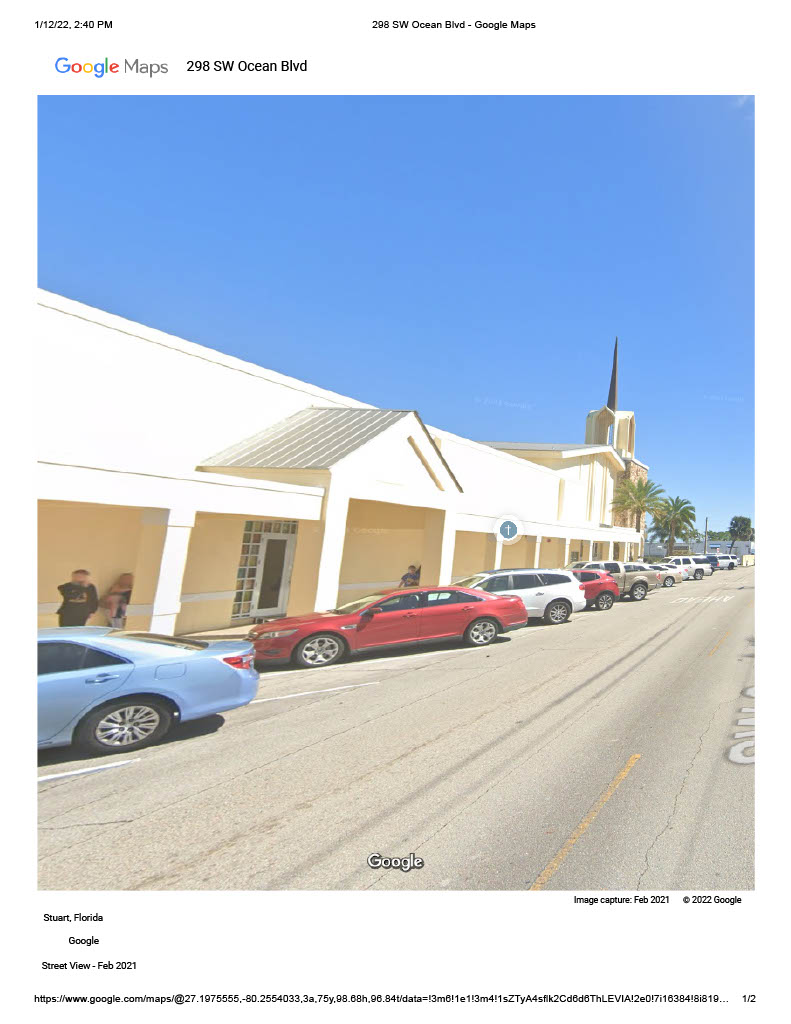
We should take places like the Baptist Church property that is for sale and the entire north side of Ocean Avenue from Dixie to U.S. 1, and have it rezoned and changed to a form-base code neighborhood. In that way a perspective developer will know what to build as of right. Once done, the commission should then stay out of the way and only allow it to be developed using the criteria within the window adopted.


Stuart commissioners and all governments are not very good at this part of running cities. They should bring their vision to a neighborhood then be confident enough to have the owners implement it. This may take decades for the vision to be built, but then the product will be much better than the one the current antiquated system is producing.


Why Martin County Needs A Rural Resort Land Use

Once again, Martin County finds itself without the right development code in place to move projects to completion.


I have written about the Discovery Land project on Bridge Road before. It will bring extremely expensive homes to the county in a resort setting. For all intents and purposes, there will be millions in tax revenue and require little in county services. Those who believe that placing enough roadblocks up will deter development are dreaming.

Suburban Sprawl

Discovery will bring many fewer units than what would be built in a more traditional development project. The choice is several hundred units worth millions each or several thousand worth $300,000 each. The latter would require many county services, and the former would not.


Most of the land in the Discovery project will remain undeveloped. In addition to the construction jobs which are always temporary, there will be a slew of others to support the resort plus ancillary businesses like shops and restaurants. To me it has always been an easy choice…the feared Browardization of thousands of rooftops or a few rich ones.


That doesn’t mean that development of Discovery will not come without rules. Right now, it does not seem current code quite fits the “rural resort” nature of the project. I understand staff and the applicant are attempting to write the code but is that the best way to go forward?


This project and others that may come after may be more than the staff can handle. And to rely on the applicant to help define the code changes necessary may not be the best for the county. The county needs to hire a consultant to expeditiously write what is necessary to move forward. Commissioner Smith is very fond of the Treasure Coast Regional Planning Council. As time goes by, I have become a convert.


The county should get a quote from the council and others if it wants to write the best code for “rural resorts” for the benefit of all the parties. That would also take an immense pressure off the Growth Management department. At the same time as a neutral third party, the council would be able to more fairly hear the concerns of all sides.


There are several other projects that are in the wings that would fit the rural resort criteria, e.g., very high-end golf courses. These are not golf course communities but rather places where the rich fly in to play golf for a couple of days like Michael Jordan’s existing club. This type of development would be preferred to having endless rooftops in western Martin.


In my mind, this is smart development. People have a right to develop the property they own. Let’s make it easy for them to do so by creating a rural resort classification. At some point, the Harmony development, and others like it will end up being built if alternatives are not provided. In my opinion, that is what most Martin County residents want to see.


The government does not own the property…private property owners do. A well-written land classification may help keep endless seas of rooftops from the area. I think that is the smart way of having the inevitable growth.

Restaurant Service

Why do we go to restaurants?


We each have different reasons. A special occasion is one reason. Many of us eat out one, two or more times per week. I have friends that never make dinner.

I am the cook in our family and a good one. My wife does the cleanup. As a treat and given our busy schedules, once or twice a week we go out.

I enter a new restaurant with high hopes and anticipation. Yet more and more often, I leave disappointed. Sometimes it is the food. It can be poorly prepared, overly ambitious in its presentation or just plain awful. When that happens, I will go back after a while to see if it was just a bad night or something more. Seldom will I give it more than two tries.


I like eating out because I want to be served. Too often that service is poor in quality. You will see poor service in all types of dining establishments. The industry is known as the hospitality industry for a reason, and restaurant staff need to understand that concept.


I grew up in the restaurant business. I worked in restaurant kitchens and dining rooms. I toiled in hotel dining rooms, catering halls, places with French service, casual restaurants, and greasy spoons. Each type of establishment has differences in the food served. How formal or casual the service is will depend on the type of restaurant. However, casual dining does not mean inferior service.


In places that were formal, the Maître D’, captains, servers, and bussers were professionals. They were not ever going to be anything else but restaurant people. Occasionally, there would be someone like me, a student or as a second job. Even the short timers knew what was expected in the dining room.


I have two recent examples of what is unacceptable service and two of very good service. We recently ate with another couple in a restaurant in Hobe Sound. With everything I had heard about it, I planned on having an excellent experience. Was I wrong!


The server, a young lady, announced that she had just started at the place. I don’t know why that should make a difference. She then disappeared for 15 minutes and re-appeared to take our drink orders. Then another 15 minutes passed before coming back with the drinks…a vodka on the rocks and a glass of wine, not exactly complicated cocktails.


Every diner at the table should be finished with their meal before removing any plates. I have a particular peeve about that, and I cannot say how many times I have admonished a server for doing so. She fell right into that trap. She also had half the orders wrong, brought appetizers out for us at different times, and kept announcing that she had just started as if it were her get out of jail free card.


A couple of weeks later, we are eating in another restaurant when almost the same excuse was used by the server, “I have only been working for three days.” My wife and the other couple could not have been more accommodating when she made the same mistakes as the previous server in the other restaurant.


Finally, when she got the order wrong, drinks mixed up, left the water glasses unfilled, and many other mistakes, I had had enough. When my wife and the others continued to reassure her, she was doing just fine.  I said no she wasn’t. This is her profession for right now. She is expecting a tip and she is getting paid. She should spend some time learning her profession. Harsh…maybe?


I have heard many say there isn’t enough people to work. I don’t buy that excuse. During the same period, I went to two comparable places in ambience, price, and type of food. We had professional service.


There were plenty of servers and bussers on the floor. I also saw managers and owners that knew their business and would not have allowed mediocre service or food in their establishments. A new hire should always be assigned to an experienced employee to learn the ropes. The staff in these restaurants were professionals. The owners made sure that the employees knew that there was a team effort to serve customers.


It is about time that we return to the days when working in restaurants was treated as an occupation and profession not a fill-in until something better comes along. And you should never hear, “I have only been doing this for 3 days.”


Sometimes Politics & Elections Do Not Go Together

School boards across the country have been in the crosshairs of parents, teachers, and state officials this year.

Much of the public’s rancor is of the boards own making. In some part, this is because a school board member position in Florida does not come with all the power that the public believes it does. The ability of board members to raise budgets, pick textbooks, and even decide on what goes on inside schools is dictated by Tallahassee. And Tallahassee is a stern task master.


For more than a decade, the “Lords of Tallahassee” more formally known as the legislature, have pre-empted more and more authority from local control. Local elected officials see quite early on what little is in their purview to decide. Partisan political power is at the root of the problem.


The governor has decided that being a conservative was not good enough. He also wanted to be a populist. That resulted in politics interfering with home rule authority. I agree on his school policies in many instances. Yet he is going about it with all the make-believe tough talk populism that makes public discourse so grating on a civil society.


Over twenty years ago, the voters of Florida decided to make school board races non-partisan in a ballot initiative. The legislature now wants to reverse course and make sure that partisanship enters schools. Senator Gruters is the chair of the Ethics & Elections committee and is pushing the legislation. He is also chair of the Republican Party of Florida.


What will happen if the races go back to partisan politics in Martin County…probably nothing. All five current school board members are registered Republicans as are all five members of the county commission and the five constitutional officers. Do you know why everyone here is a registered Republican? It is because in deep red Martin County that is the only way you can be elected.


If we inject a partisan primary into school board races, then many times Democrats and NPA voters will be prevented from voting. One county commissioner regularly closes out races by having an ally run as a write-in candidate. If a primary race is closed by a write-in candidate, then only members of the party can vote in that primary. The last time, the commissioner had a high school student as his opponent in the general election. Is this what we want for our school boards in Martin County a decision by only 40% of the voters?


Florida is becoming a state where locally elected officials have no authority to enact policies and ordinances that their constituents want. From taxing authority to whether your next-door neighbor can open a business in his living room is now decided by Tallahassee.


The legislature has consciously determined, along with Governor DeSantis, to not allow elected local leaders to make policy in their communities. If everything is decided by the 160 senators and representatives in the Florida legislature and the governor, then we have a politburo and not a representative government. Our liberty is being taken away little by little by the consolidation of political power in the hands of fewer and fewer.


They can shout how they are protecting the people, but the people have fewer ways of making their voices heard. Diffusion in making political decisions is the guarantor of our liberty. Consolidation of power will ultimately have despotic results. Politicizing school board races will aid in that consolidation.

Supposed Party Gains Are Actually Losses

Florida’s Republican party recently boasted that, for the first time ever, there are more Republicans than Democrats registered in the state.


That statement in and of itself is true. However, what that statement does not tell you is that party registration for the Republicans fell in 2021…. just not as much as it did for the Democrats. There were 142,414 fewer voters picking either party. The only gain in numbers were for Non-Party Affiliation and minor parties.


The largest loss for the Democrats occurred in Miami-Dade where they were down by 37,723 voters to the Republicans loss of 3,592. In three counties, Sarasota, Volusia, and Sumter, Democrats increased membership. Republicans had gains in 13 counties including next door in St. Lucie. Martin County, long a bastion for Republicans, lost 1607 voters in 2021 as compared to 2020. So, what gives?


Florida and the United States may just be tired of celebrating party over everything. More and more voters may be saying that they are just not interested in the incessant political wars that Democrats and Republicans want to wage with each other. Could it be that many voters are tuning out and refusing to be labeled?


Rationality may be the death knell for political parties. Yet those that remain within the party fold are more partisan. While the Founders never wanted political parties and warned against factionalism, our entire political system is tied to having “them” and “us.”


If we cannot get a handle on this hatred by members of one party over those in another, we may find ourselves increasingly edging toward a civil breakdown. We are moving closer and closer to one party states with gerrymandered districts. That has and will continue to lead to the extremism that Madison, Hamilton, and Jay warned to beware of.

Jensen Mooring Field: Will It Be Folly Or Resource?

Will it be another Martin County folly or a valuable resource? That is the question I have with the viability of the Jensen Beach Mooring Field.


I am not yet ready to pronounce it as an intrusion into the private sector that will go down as another example of commission hubris. There could be a need for the service and a public that is willing to pay for it. But I have my doubts.


We should not forget that the first dock built needed to be torn out because the engineers failed to consider currents and wave action. We should also bear in mind that there is no law that requires boaters to be tied to a mooring ball instead of just dropping anchor anywhere outside of a navigation channel.

I am quite familiar with mooring fields because the Stuart Anchorage is located off my dock. Those that choose to use a ball are responsible boaters. Their vessels are pumped out so that their sewage doesn’t hit the water. Those boaters are out of the navigation channels. They are good neighbors.


Then occasionally, there will be what I call a boat bum who just drops anchor. The last boat bum simply dropped anchor at the end of my dock and was there for about three years. His sailboat had no workable engine and I never saw the sail unfurled. Yet he had a registration sticker which was all he needed to have. That is when I learned that a mere citizen cannot report someone dumping waste. It must be law enforcement that sees the violation being committed.

The owner of the boat was in the hospital and/or jail for a prolonged period. The registration expired. Law enforcement was able to then declare that the boat was abandoned and remove it. That may have been one of the ten best days of my life when that occurred.


My point is that a mooring field is not going to stop illegal dumping or prevent anchors from destroying sea grasses. It is not going to stop some inexperienced owner from anchoring his boat improperly before a hurricane and the vessel winding up destroying a dock when it comes lose.


What the Jensen Beach Mooring Field may do is provide a cheaper alternative to boaters who do not want to pay a private marina. Stuart’s Anchorage works because it is close to downtown. You can catch the tram once you dock your dinghy at the Marina. There is a Publix within walking distance. While you can walk to downtown Jensen Beach, it doesn’t have the same allure.


I am willing to give it the season to see whether it was the right thing to do or another waste of taxpayer money. Even if it is arguably the right thing to do to prevent dumping, preserving sea grass beds, and shorelines from being ravaged, will it? Boaters must stop throwing anchors down for free and begin paying to have their vessels safely moored. Without enforcement capabilities, I think we know the answer already.


The Stuart LPA Did The Right Thing In The Wrong Way

I watched Stuart’s last LPA meeting. The public, the applicant, and the board were not on their best behavior.


Staff for their work received blame from members of the LPA. While sometimes I think that staff does phone it in, I do not believe they did so in this instance. They presented the information that they are legally obligated to do. Some LPA members took it out on them as if the development department has the option to reject projects because board members may not like them.


Members of the public brought up issues which the city has no control over such as traffic on county and state roadways. People forget developers pay impact fees for their projects to Martin County. The county seldom uses those impact fees to alleviate road problems where the new project is being built. Doing nothing gives a couple county commissioners an excuse to bash Stuart even though the results are because of their inaction.


The applicant, not his experts, believed he could roll over staff and the LPA. Meritage was condescending which does not help win favorable decisions. They seem to have an ongoing problem with playing nice with others.


A couple of members of the board, though, were way out of line. Perhaps it was sheer ignorance on their part about what their roles are. Mr. Campbell Rich, a board member, and Chair Kelly Laurine arrogantly shot question after question to staff and the applicant’s experts. Rich all but said that one witness was manipulating data even though she used data that she was mandated to use by law. And Laurine, at least at this meeting, played instigator instead of chairing and bringing a semblance of order.


If the LPA had been the final decision makers, then this may have gone to court to be overturned. It amazes me that members of this board don’t quite realize that they are advisory. Their decision is non-binding on the commission which will have the final determination.


With all that said, the 5-0 (one abstention and one absence) decision not to approve this project going forward was the right one. The zoning is currently commercial and other property in the area is commercial. That alone would have given this board (and I hope the commission) the reason to deny the RPUD. There didn’t need to be the histrionics that surrounded the meeting.


One thing that Rich said which is true is that there are several thousand units coming online within the next few years. While I do not think that this is too many units, I do believe the city should allow absorption of these new units to occur before allowing anything that isn’t “as of right” to be built except within the CRA.


Stuart needs to build their new fire/rescue station. They need to have storm water issues under better control especially in non-CRA areas. Do we need a Zoning-in-Progress (ZIP) to study the code? I do not think so. Outside the CRA you can build no more than 15 units per acre without going through the PUD process.


We have adequate zoning in place. The commission just needs to vote no in changing it if asked. There is no “Bert Harris” claim unless the commission does not allow someone to develop a piece of property using the zoning and codes that are currently in place.


The CRA is where density should be. That will give Stuart the walkable city…the supposed small town feel and not the suburban one so many push. You cannot have that without density. Within the CRA, there are no parcels of more than 2 acres. They will all be infill projects. Isn’t that what the city should be all about?


Not having a ZIP does not prevent the commission from looking at whether to change certain codes such as better and more innovative storm water concepts. Development as of right outside the CRA will prevent large projects for a while until absorption of the new units can occur and then the commission can reassess.


If they are absorbed quickly (within 18 months of a project’s completion), then it proves that the housing is needed and necessary. That would justify what the commission has approved. During this “break,” it should be incumbent on the city to pressure the county to make all needed improvements to roadways and use those impact fees for the benefit of the residents who are affected by new projects.