
Stuart is trying to implement form-based code in East Stuart and the Creek District. I hope that they do.
By doing so, the people who want to develop the properties they own within those areas know ahead of time what can be done. This should help end the many PUD applications that come before the commission. However, the commissioners would have to resist the temptation to insert themselves in the process going forward or otherwise they defeat the purpose of enacting that type of code.
Form-based code develops neighborhoods rather than individual projects. It takes a holistic approach. What this city and commission is used to doing is tweaking projects. Commissioners suggest to developers that they will vote to approve a project if the developer knocks a floor off here or puts a tree there. You need fifty parking spaces according to code but only have room for thirty-five, this is what you must do the commission tells the applicant.
The problem with that scenario is there is no consistency. Form-base code substitutes endless pages of tables and rules and states this is what the city wants to accomplish in this area. How the space is filled in the parcel is up to the developer. Another way to phrase form-based code is that a picture is worth a thousand words.
Ironically, by trying to exercise control over individual projects, the projects are often not as well implemented and designed as they should as part of an integral design for a neighborhood’s character. For example, consider parking. The lack of enough parking spaces as required by code has stopped many businesses from opening. While on Federal Highway, parking calculations are the explanation for empty parking lots, unfriendly streetscapes, and buildings set so far back that an observer can’t make out what businesses are located there.
Downtown Stuart has an excess of parking. There is no question about it. What it doesn’t have is a parking space for every customer directly in front of every business. Cities weren’t designed for that. Throughout the CRA, excess parking calculations to build a building or open a business have resulted in buildings not being developed or businesses not opening.
There are eight spaces for each car in the United States. Estimates are that 1/3rd of the land in cities is dedicated to parking. About 30% of a building’s cost are due to having code-required parking spaces. This is not sustainable.
Stuart must stop thinking in terms of 1960 and think about 2060 which is closer to the present. Within most of our CRA, we should forget about mandating how many parking spaces are needed for each apartment, home, or business. If parking becomes acute, then the private sector will build a garage. People who build housing know what they will need to make sure their buyers or tenants will live in the properties. The same for restaurants and stores. With all the complaining, how many businesses downtown have closed because of parking issues?
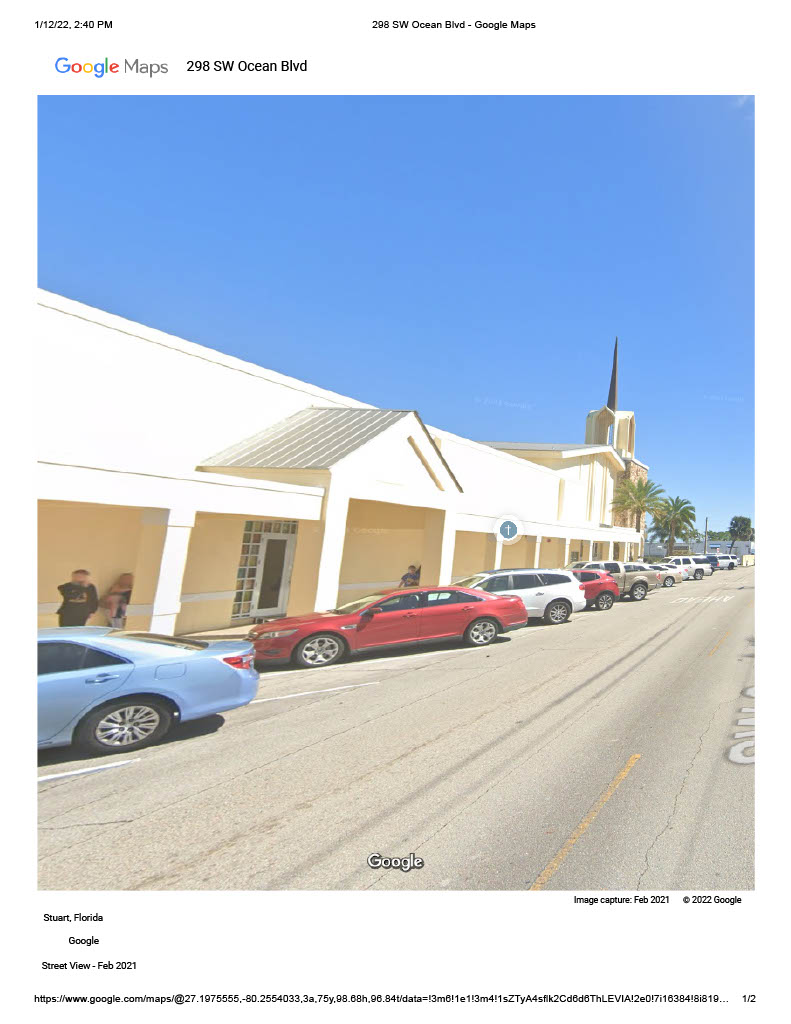
We should take places like the Baptist Church property that is for sale and the entire north side of Ocean Avenue from Dixie to U.S. 1, and have it rezoned and changed to a form-base code neighborhood. In that way a perspective developer will know what to build as of right. Once done, the commission should then stay out of the way and only allow it to be developed using the criteria within the window adopted.
Stuart commissioners and all governments are not very good at this part of running cities. They should bring their vision to a neighborhood then be confident enough to have the owners implement it. This may take decades for the vision to be built, but then the product will be much better than the one the current antiquated system is producing.